Guide · VAT
The VAT margin scheme for used vehicle dealers.
The margin scheme lets a VAT-registered dealer pay VAT on the difference between what they paid for a used vehicle and what they sold it for, instead of on the full selling price. This guide explains HMRC's rules for cars, vans, motorhomes and caravans in plain English, with links to HMRC's own pages.
Based on HMRC's guidance on gov.uk, read on 18 November 2026. VAT Notices 718 and 718/1 have been withdrawn and their guidance moved to these pages on 2 November 2026. This is general information, not tax advice: check anything that matters with your accountant or HMRC.
What is the VAT margin scheme?
Under a margin scheme you pay VAT on the margin: the selling price less the purchase price. At the standard rate the VAT due is one-sixth of the margin. You don't need to register for the scheme: you start using it by keeping the right records and reporting it on your VAT return. If you don't meet all the scheme's requirements, you pay VAT on the full selling price. HMRC: VAT margin schemes.
Cars and other motor vehicles are under different margin schemes in law, but HMRC says that for practical purposes the treatment is the same. HMRC: Buying and selling second-hand motor vehicles using the VAT margin scheme.
When can a used vehicle go through the margin scheme?
When it is second-hand and you bought it without VAT being charged to you: usually from a private seller, from a business that doesn't charge VAT, or from another dealer selling it under the margin scheme. HMRC: Goods eligible for the VAT margin scheme.
You cannot use the margin scheme for:
- New vehicles. Registration and delivery mileage don't make a vehicle used for the margin scheme
- Any vehicle bought on an invoice that shows VAT separately, whether or not you reclaim that VAT
- Vehicles imported into the UK, with some exceptions
- Category A and B write-offs
- Vehicles bought in Great Britain for resale in Northern Ireland, which have rules of their own
If a vehicle isn't eligible, you charge and reclaim VAT in the normal way. HMRC: Buying and selling second-hand motor vehicles using the VAT margin scheme.
Used vans: why so many are sold plus VAT
Many used vans come from businesses that charge VAT when they sell them, such as fleet and lease companies. A van bought on an invoice that shows VAT can't go through the margin scheme, even if you didn't reclaim the VAT. So it is sold at the standard rate, with VAT on the full selling price, and a VAT-registered buyer can usually reclaim it. A van you bought from a private seller, with no VAT charged, can usually go through the margin scheme instead. HMRC: Buying and selling second-hand motor vehicles using the VAT margin scheme.
So the same dealer often sells some vans under the margin scheme and some at the standard rate. Each vehicle needs to be set up the right way from the day you buy it.
Motorhomes, campervans and caravans
A motorhome or campervan is a motor vehicle, so the vehicle rules above apply. Caravans are not motor vehicles: a second-hand caravan can go through a margin scheme if it doesn't meet the criteria for zero-rating, and there are special rules for the removable contents when a zero-rated caravan is sold. HMRC points to its caravans and houseboats notice (VAT Notice 701/20) for those. HMRC: Buying and selling houseboats and caravans using the VAT margin scheme.
How to work out the margin and the VAT
Take the purchase price away from the selling price to get the margin, then multiply the margin by the VAT fraction: one-sixth at the 20% standard rate. HMRC: How to work out the margin and VAT due using VAT margin schemes.
If the purchase price is the same as or more than the selling price, there is no margin and no VAT is due. You show the margin and the VAT as nil in your stock book. HMRC: Recording VAT margin scheme transactions.
A made-up example
- You buy a used motorhome from a private seller
- £20,000
- You sell it for
- £23,000
- The margin
- £23,000 less £20,000 = £3,000
- VAT due, one-sixth of the margin
- £500
The VAT is worked out on the margin, not on the profit you made after costs.
Prep, repairs and conversions don't go in the purchase price
Your purchase price is everything you paid for the vehicle, and nothing else. HMRC says you must not add the cost of preparing it for sale, repairs, refurbishment, accessories or business overheads. You can reclaim the VAT you're charged on those costs under the normal rules. HMRC: Buying and selling second-hand motor vehicles using the VAT margin scheme.
Your selling price is everything you receive for the vehicle, from the buyer or anyone else. It includes incidental costs linked to the sale, such as an MOT you had to pay for to make the vehicle saleable, and accessories fitted before the sale. If you sell a vehicle with an MOT, you don't take the MOT off the selling price. HMRC: Buying and selling second-hand motor vehicles using the VAT margin scheme.
Part-exchange: the value you give a part-exchanged vehicle is part of your selling price for the vehicle you sell. It is also the purchase price of the part-exchange when you sell it on, and you must not reduce the selling price by the value of the part-exchange. HMRC: Buying and selling second-hand motor vehicles using the VAT margin scheme, and HMRC: Other products and circumstances affecting the second-hand vehicles VAT margin scheme.
What the stock book must show
As well as your normal VAT records, you keep a stock book that tracks each margin scheme vehicle on its own, and copies of the purchase and sales invoices. You keep VAT records for 6 years. HMRC: VAT margin schemes.
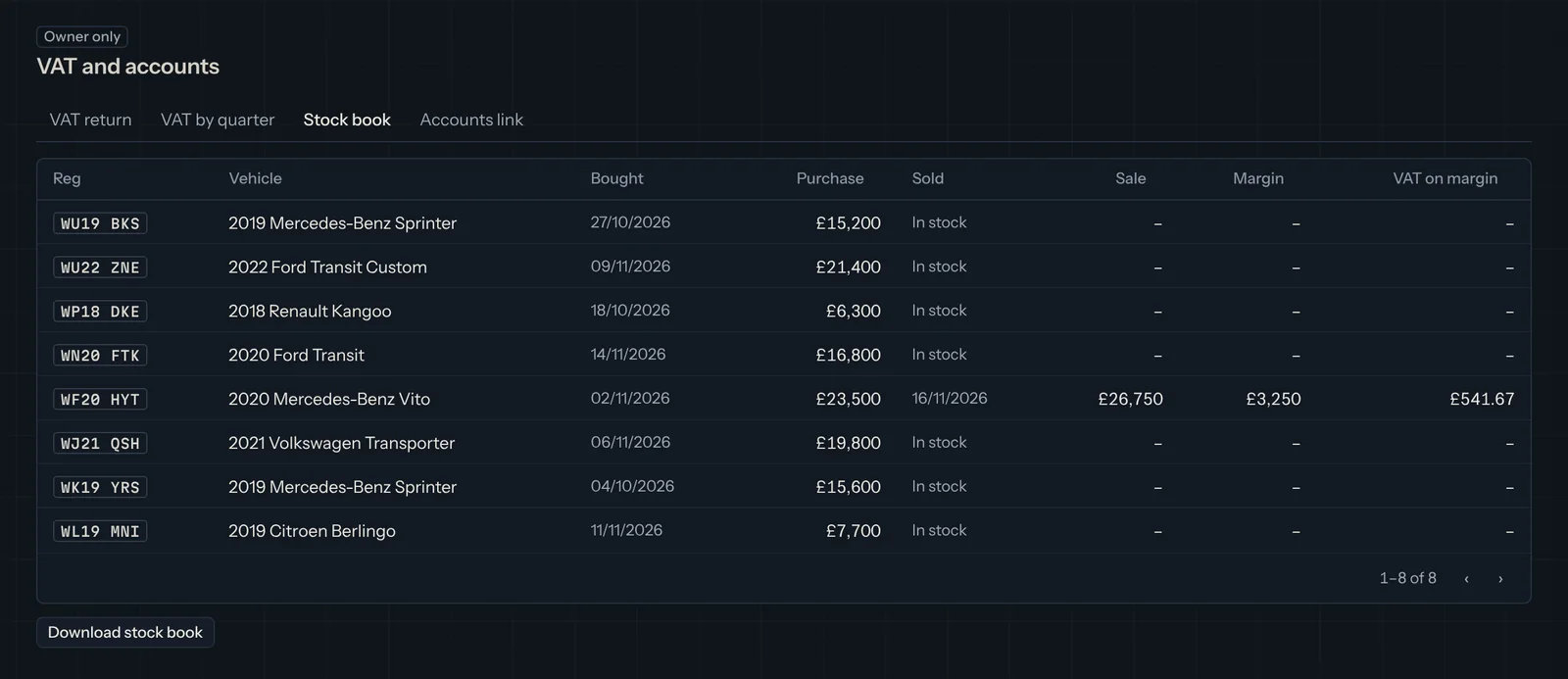
For vehicles, HMRC also wants the registration number (or the VIN if there is none) and a description such as the make and model on the purchase and sales invoices and in the stock book. If the registration changes between purchase and sale, record that too. HMRC: Buying and selling second-hand motor vehicles using the VAT margin scheme.
- Stock number, in sequence
- Date of purchase and date of sale
- Purchase invoice number and sales invoice number
- Purchase price and selling price
- Name of the seller and name of the buyer
- Description of the vehicle, and its registration or VIN
- Margin on the sale, and the VAT due
The sales invoice and the VAT return
A margin scheme sales invoice must not show VAT separately. It shows the date, your name, address and VAT number, the buyer's name and address, the stock book number, the invoice number, a description and the total price, and a note such as "margin scheme: second-hand goods". HMRC: VAT margin schemes.
On the VAT return, box 1 includes the VAT due on the margin scheme vehicles you sold in the period, box 6 the full selling price less that VAT, and box 7 the full purchase price of the margin scheme vehicles you bought. Margin scheme purchases and sales don't go in boxes 8 and 9. HMRC: VAT margin schemes.
How Forecourt helps
Margin scheme or standard rate, set on each vehicle.
Forecourt is a dealer management system for small UK dealers. Each vehicle is margin scheme or standard rate, and Forecourt works out the VAT when it sells. It keeps the VAT stock book, ready to download, and builds up the VAT return figures, boxes 1 to 9, for your accountant to check. Prep costs are kept against the vehicle, outside the margin.
Questions about the margin scheme
Is VAT on a margin scheme sale 20% of the margin?
No. At the 20% standard rate the VAT due is one-sixth of the margin (16.67%), because the margin is treated as including the VAT.
Can I use the margin scheme on a van I bought from a VAT-registered business?
Only if it was sold to you under the margin scheme, with no VAT shown on the invoice. If the invoice shows VAT, you cannot use the margin scheme for that van, even if you did not reclaim the VAT.
Do prep and conversion costs reduce the VAT on a margin scheme sale?
No. They are not part of the purchase price, so they do not change the margin. You can reclaim the VAT charged on them under the normal rules.
What if I sell a vehicle for less than I paid?
There is no margin, so no VAT is due. You record the margin and the VAT as nil in the stock book. A loss on one vehicle is not set against the margin on another.
Do I need to register for the margin scheme?
No. You start using it by keeping the right records and reporting margin scheme sales on your VAT return.
Where are VAT Notices 718 and 718/1 now?
They have been withdrawn. HMRC moved their guidance into its gov.uk guidance pages on the margin scheme, which this guide links to.
Sources, all HMRC on gov.uk, read 18 November 2026: Buying and selling second-hand motor vehicles using the VAT margin scheme; How to work out the margin and VAT due using VAT margin schemes; Goods eligible for the VAT margin scheme; Recording VAT margin scheme transactions; Other products and circumstances affecting the second-hand vehicles VAT margin scheme; VAT margin schemes; Buying and selling houseboats and caravans using the VAT margin scheme. Forecourt is made by Sitesmith Ltd, which is not connected with HMRC.
The demo
See VAT worked out on every sale: try the demo.
You're trying Forecourt Plus, with every feature.This is the whole of Forecourt, not a cut-down version. No sign-up, nothing to install.